
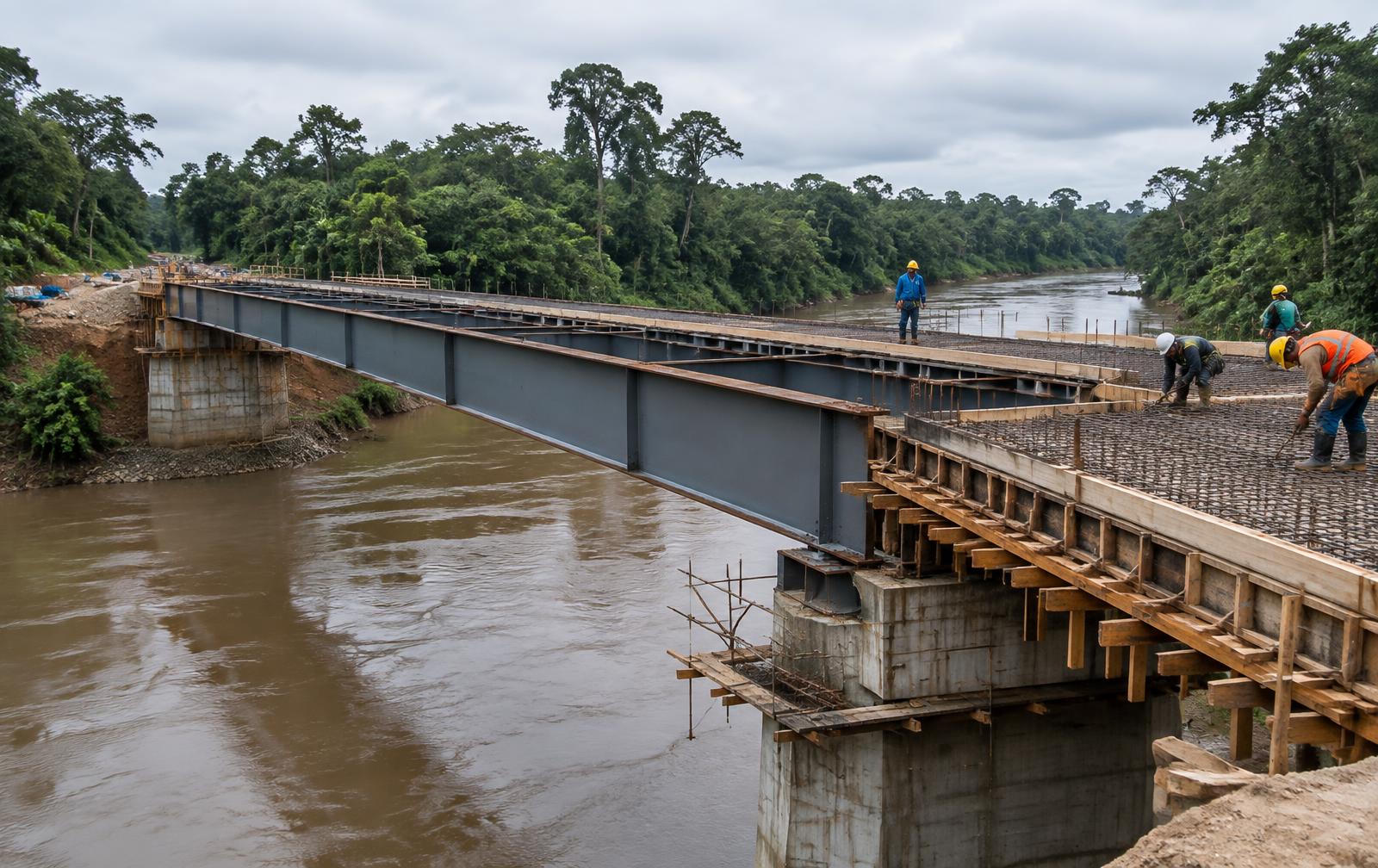
On a rural road, the river crossing is often the point that decides everything. A submersible ford, a timber footbridge, a tired old bridge: as long as the crossing is fragile, the whole road is too. Designing a durable structure begins by looking at the site as a landscape, not merely an obstacle.
Reading the valley
A river occupies a main channel in the dry season and can spread across a flood plain during floods. Valley width, bank height and vegetation give valuable clues. Residents remember high water: their accounts usefully complement the available data.
Understanding the ground
Foundations are the part of the structure nobody will see, and the part everything depends on. Investigations and tests by an accredited laboratory make it possible to choose foundations suited to the ground. On the Endama – Elig Bitstetsa road, the foundations of the Medjoa and Lékié crossings were studied this way before execution.
Choosing the right structure
- A pipe culvert, with headwalls and sump, for a small stream.
- A reinforced-concrete box culvert as flow increases.
- A steel-girder bridge with a reinforced-concrete deck when the span requires it.
The choice rests on hydraulic studies and the supervising engineer; our role is to build the selected structure, adapting it to actual ground conditions.
Protecting the supports
Abutments and piers face the push of water and the risk of scour — erosion of the ground at their base. Wing walls, stone pitching and rock armour protect supports and guide flow beneath the structure.
Tying into the road
A bridge is only useful if its approaches are. Approach embankments must be compacted, drained and protected; otherwise settlement creates a step at the deck entrance. Road drainage must also discharge to the river without eroding the banks.
Thinking of those who cross
Footways, parapets and visibility on the approaches: on a rural road, pedestrians — often children on their way to school — use the same structure as lorries. Their safe passage is part of the design.
Strengthening rather than replacing
Sometimes the existing structure can be kept. On the Song Mayo – Ngompem road, a 12 m bridge was strengthened with an additional steel girder and rework of its deck, wing walls, bearings, deck drains and parapets. Well-studied strengthening extends a structure's life at lower cost.