
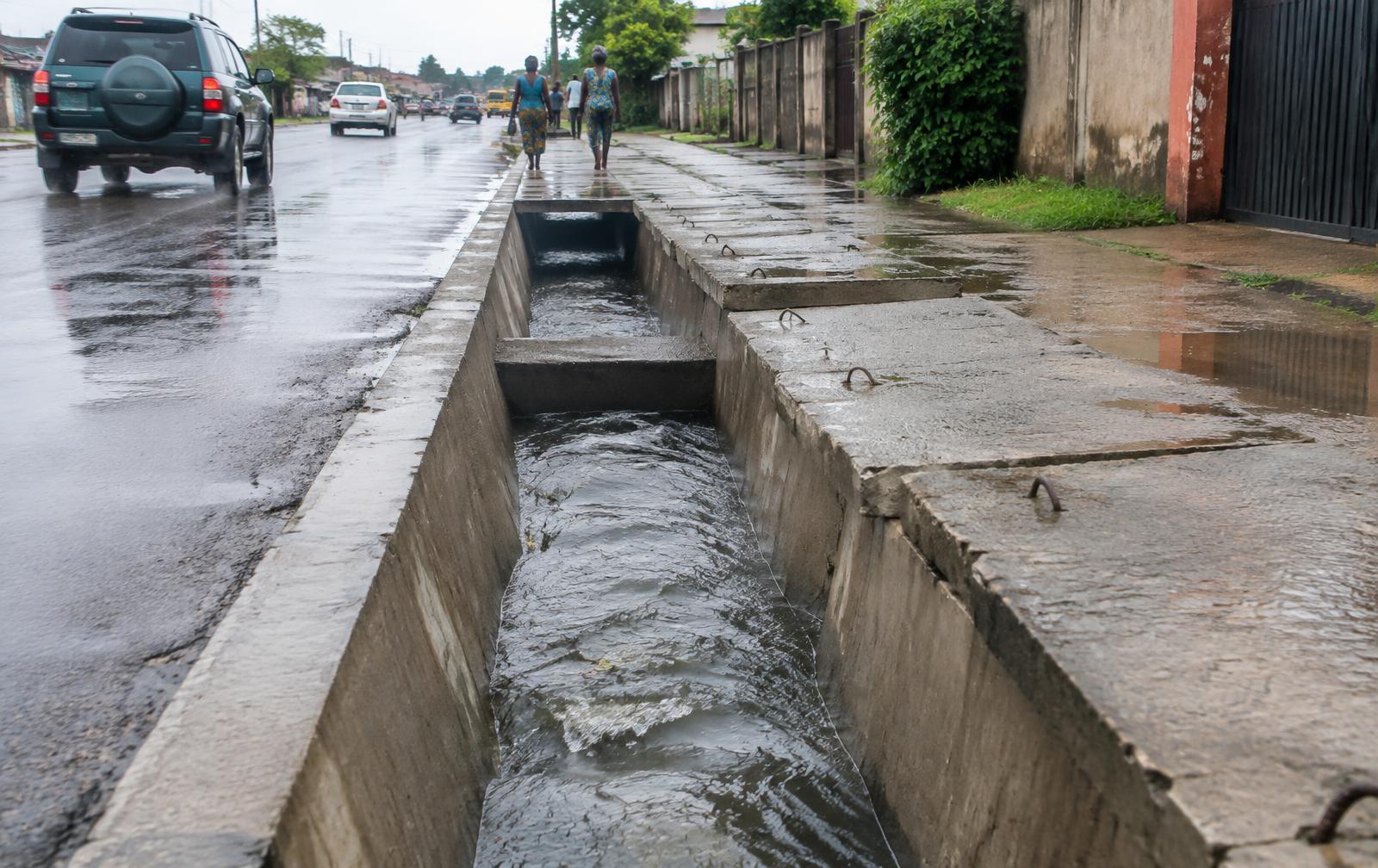
When you visit a rural road damaged after a rainy season, the diagnosis almost always comes back to the same point: the water did not find its way. It seeped into the pavement, ponded on the shoulder or gullied the slope. Traffic only finished what the rain had started.
A pavement carries load because the ground is dry
A pavement is a stack of layers — formation, sub-base, base, surfacing — that spread vehicle loads down to the ground. That spreading assumes the materials keep their strength. Yet most formation soils lose much of their bearing capacity when saturated. A load easily carried by dry ground causes deformation on waterlogged ground: ruts, potholes, then loss of surfacing.
Three paths for water
Water reaches the pavement in three ways, each calling for a response:
- From the surface: the crossfall of the pavement and shoulders must shed water to the ditches without ponding.
- From the sides: runoff from slopes and neighbouring land must be intercepted by ditches, concrete-lined where gradients risk erosion.
- From below: at low points and stream crossings, pipe or box culverts must let water pass beneath the road rather than build up against the embankment.
Why drainage comes first
On our road sites, drainage structures are set out and built before the pavement layers. This is not only a matter of logical order: a formation that stays drained during works compacts better, and laboratory tests are more representative of its behaviour in service. Outfalls are opened and protected first, then cross structures, and finally longitudinal ditches and drains.
The detail that matters: the outlet
A ditch that leads water to a poorly protected point simply moves the problem. At the outlet of a culvert, water velocity can scour the ground and eventually threaten the structure itself. Stone pitching and engineered outfalls are therefore full parts of the project, not finishing touches.
In town: the residents' question
On urban streets, drainage meets another constraint: access to homes and shops. Reinforced-concrete drains are then accompanied by access slabs, planned when levels are set so every resident keeps their entrance.
Key takeaway
A road lasts as long as its drainage works. That is why, when a contracting authority presents a road project, our first questions concern low points, watercourse crossings and outfalls — even before the choice of surfacing.