
Bridges and river crossings
Crossing rivers for the long term
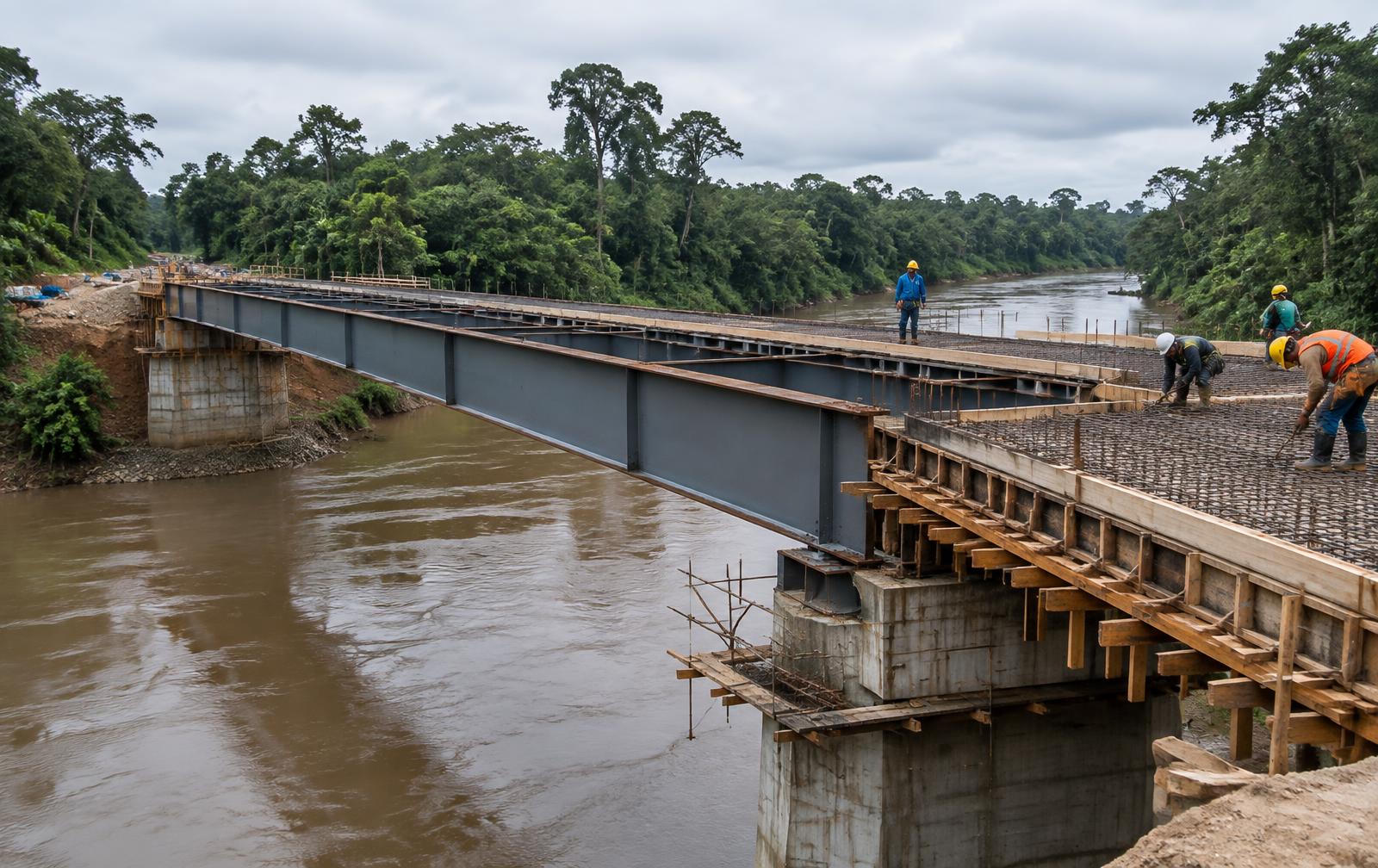
On a rural road, the weak point is often the river crossing. A temporary passage washed away by a flood can cut a community off for weeks. We build crossing structures designed for their site: bridges, box culverts and pipe culverts, with their abutments, supports and protection.
01The needs we address
A crossing sits within a landscape: a valley, a main channel and a flood plain, shifting banks, floods residents remember. The structure must let the water through and carry the traffic.
- Replace a temporary or damaged passage with a permanent structure.
- Strengthen an existing bridge to carry traffic.
- Restore water flow beneath the road.
02What we study
- a.Valley topography and the road's long profile on the approaches.
- b.The watercourse regime: flood levels, debris, bank erosion.
- c.Foundation soil, through investigations and tests by an accredited laboratory.
- d.The condition of the existing structure when strengthening.
- e.Access for plant and girders to the site.
03Technical scope
Foundation studies
Investigations and tests by an accredited laboratory; foundations adapted to the ground encountered.
Supports
Reinforced-concrete abutments and piers, wing walls and scour protection.
Deck
Steel girders, formwork and casting of the reinforced-concrete deck, bearings and deck drains.
Fittings and safety
Footways, parapets and details that make pedestrian and vehicle movement safe.
Strengthening
Additional girders, rework of deck, wing walls, bearings and parapets on an existing structure.
Culverts and approaches
Reinforced-concrete box culverts, pipe culverts with headwalls and sumps, stone pitching and approach embankments tied into the road.
04Execution sequence
- 01
Site reconnaissance
Watercourse regime, banks, access and site constraints.
- 02
Geotechnical study
Foundation investigations and tests by an accredited laboratory.
- 03
Execution drawings
Submitted to the supervising engineer and adjusted to study results.
- 04
Foundations and supports
Carried out outside high-water periods wherever possible.
- 05
Girders and deck
Girder placement, formwork, reinforcement and deck casting.
- 06
Fittings and acceptance
Parapets, protection, approach fills, inspection before opening and acceptance.
05Interfaces
- Supervising engineer: approval of drawings and test results.
- Accredited geotechnical laboratory: investigations, tests and foundation recommendations.
- Road teams: tie-in of approach embankments and drainage.
- Residents and users: a safe temporary passage during works.
06What we hand over
- Geotechnical report and foundation notes
- Approved execution drawings
- Structure approval report
- Concreting and workmanship checks
- Acceptance report
07Preparing your project
The information that makes a first conversation genuinely useful:
- Crossing location and watercourse name
- Estimated span and condition of the current passage
- Observations on known floods
- Existing studies: survey, hydrology, geotechnics
- Expected traffic (pedestrians, light vehicles, heavy goods)
- File stage and schedule
08References
Endama – Elig Bitstetsa road and crossings of the Medjoa and the Lékié
Double surface-dressed road and crossings of the Medjoa and the Lékié, Elig-Mfomo (Lékié), delivered in consortium (2021 contract awarded to the KHAYROUAL GROUP SARL / ETS EBESCA consortium).
Location
Lékié · Centre
Song Mayo – Ngompem road, phase I, and 12 m bridge
Rural road with pipe culverts, concrete-lined ditches and strengthening of a 12 m bridge, Sanaga-Maritime.
Location
Sanaga-Maritime · Littoral
09Frequently asked questions
Which structures do you build?
Steel-girder bridges with reinforced-concrete decks, reinforced-concrete box culverts and pipe culverts with their headwalls and sumps.
Why a geotechnical study?
Because the foundation governs how the structure performs. On the Endama – Elig Bitstetsa road, crossing foundations were studied in 2023 by an accredited laboratory before execution.
Do you strengthen existing bridges?
Yes. On the Song Mayo – Ngompem road, a 12 m bridge was strengthened with an additional steel girder and rework of the deck, wing walls, bearings, deck drains and parapets.
How do you account for floods?
Through reconnaissance of the watercourse regime, residents' knowledge and available data, to set the structure and its scour protection.
Is traffic stopped during works?
We always look for a safe temporary passage. Arrangements are agreed with the supervising engineer and local authorities.
When is a culvert preferable to a bridge?
When flow and span allow, a box or pipe culvert is simpler to build and maintain. The choice rests on hydraulic studies and the supervising engineer.
Related expertise