MV/LV electrification
Connecting villages to the grid
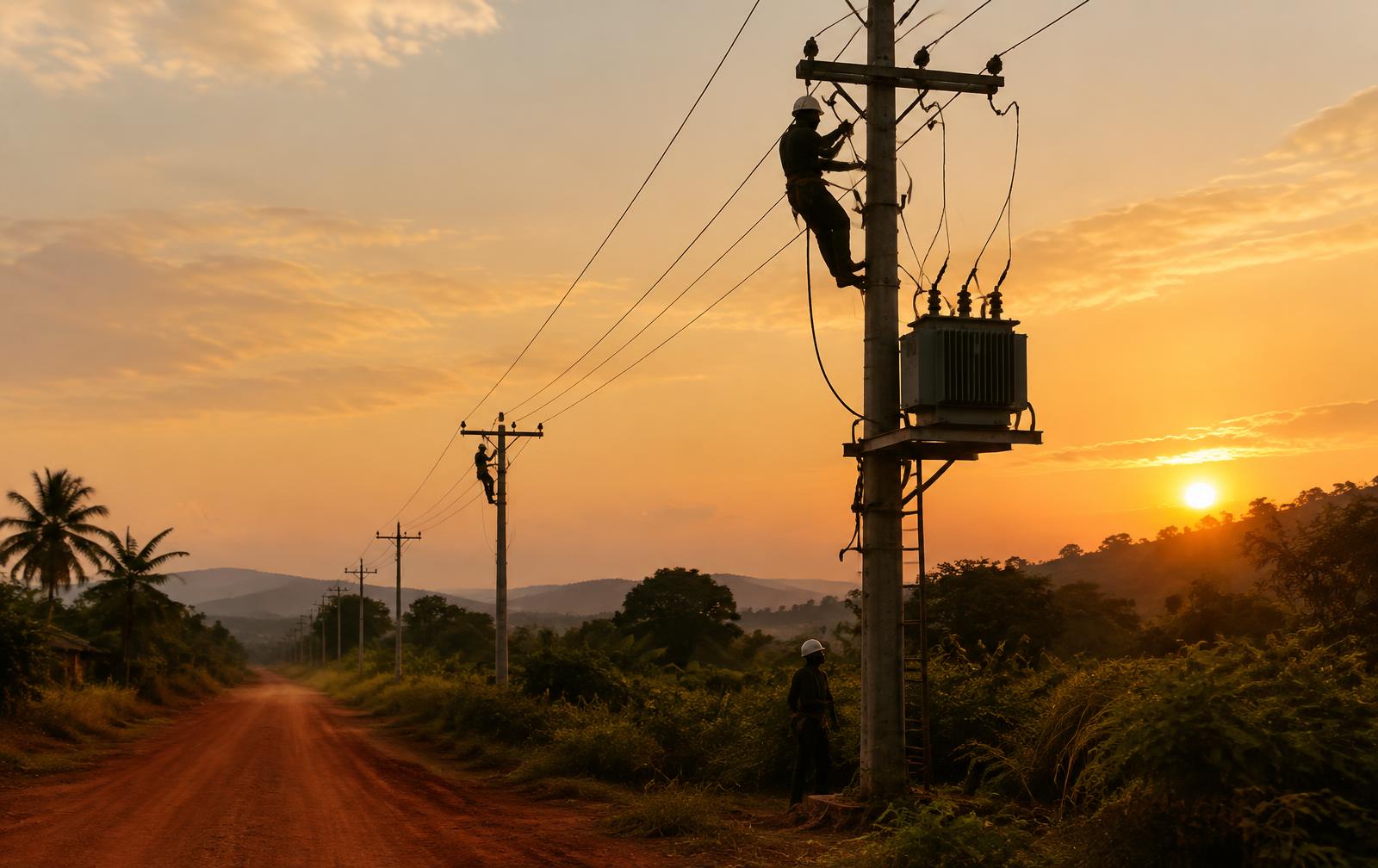
Electricity transforms a community: lighting, food storage, small trades, safety. We build medium- and low-voltage distribution networks in rural areas, through to commissioning with the network operator.
01The needs we address
Electrification starts with understanding where the homes, services and activities to be served are, then tracing the safest route for the network to reach them.
- Electrify villages.
- Rehabilitate a degraded network.
- Extend an existing network to new communities.
02What we study
- a.Needs assessment: communities, households, public facilities and activities to serve.
- b.The line route, along roads and clear of obstacles.
- c.The connection point to the existing network and its capacity.
- d.Location and rating of transformer substations.
- e.Condition of existing supports for rehabilitation works.
03Technical scope
Pegging and access
Route pegging, access clearing and support setting out.
Supports
Pole erection, cross-arms and insulators.
Lines
MV lines in almelec conductor, twisted or pre-assembled LV networks.
Substations
Pole-mounted transformer substations (H61), protection and earthing.
Connections
Household connections where provided for in the contract.
Testing and handover
Testing, preparation and recorded commissioning with the network operator.
04Execution sequence
- 01
Survey and pegging
Route approved with the supervising engineer.
- 02
Coordination
With the network operator, authorities and residents.
- 03
Supports and cross-arms
Poles, cross-arms, insulators.
- 04
Stringing and sagging
MV and LV conductors.
- 05
Substations and protection
H61 substations, protection, earthing, tests.
- 06
Acceptance and commissioning
Provisional acceptance, then commissioning with the operator.
05Interfaces
- Network operator: connection, isolation, commissioning.
- Ministry of Water and Energy: contract engineer.
- Road teams: easements along roads.
- Authorities and communities: route, vegetation clearance, connections.
06What we hand over
- Pegging drawings
- Measurement of supports, conductors and substations
- Test reports
- Acceptance and commissioning reports
07Preparing your project
The information that makes a first conversation genuinely useful:
- Communities to be served
- Intended connection point
- Rehabilitation or extension
- Existing studies
- File stage
- Schedule
08References
Ayos – Kobdombo and Carrefour Ngalla – Ebolboum – Ngoulkeka electrification
Rehabilitation and extension of the Ayos – Kobdombo power network, officially commissioned in December 2021.
Location
Nyong-et-Mfoumou · Centre
Akonolinga – Minlo electrification, phase I
Three-phase medium-voltage network, six H61 substations and low-voltage networks on the Akonolinga – Minlo axis (Nyong-et-Mfoumou).
Location
Nyong-et-Mfoumou · Centre
Works in progress
Soa – Essé MV/LV network extension
Extension of a three-phase overhead medium- and low-voltage network between Soa and Essé (Méfou-et-Afamba).
Location
Méfou-et-Afamba · Centre
Minlop – Endom electrification, phase II
Three-phase electrification on concrete poles along the Minlop – Endom axis (Nyong-et-Mfoumou), phase II.
Location
Nyong-et-Mfoumou · Centre
09Frequently asked questions
Which networks have you built?
Ayos – Kobdombo and Carrefour Ngalla – Ebolboum – Ngoulkeka (provisional acceptance 29 July 2021, official commissioning 21 December 2021) and Akonolinga – Minlo, phase I (provisional acceptance 18 November 2022).
What is an H61 substation?
A pole-mounted transformer substation that steps medium voltage down to the low voltage distributed to homes.
Do you take networks through to commissioning?
Yes, we prepare testing and commissioning, recorded with the network operator.
Do you rehabilitate old networks?
Yes. At Ayos – Kobdombo, broken or burnt wooden supports were replaced with 240 poles of 11 m.
Do you make household connections?
Where provided for in the contract, as on the first Ayos – Kobdombo section.
Which works are in progress?
The Soa – Essé MV/LV network extension and the Minlop – Endom electrification, phase II.
Related expertise